



 By Alois Gitau, A Bachelor of Science in Computer Science Third Year Student at Zetech University.
We are living through the quiet, rapid birth of a new intelligence. Artificial Intelligence is no longer a sci-fi fantasy; it’s the engine behind our social feeds, the unseen advisor approving our loans, and the filtering system deciding which job applications a human ever sees. The "future of AI" isn't a distant horizon. We are soaking in it, and it’s accelerating.
But as we race to build smarter, faster, and more autonomous systems, we're overlooking a critical fact: we are teaching machines our own worst habits.
We dream of AI as a purely objective, logical force. The reality is that we are building a mirror, and it is reflecting every flaw, bias, and prejudice of the society that created it. This isn't a technical problem to be patched later. It's a foundational ethical crisis, and it targets our dignity, our minds, and even our bodies.
The Algorithm of Discrimination
The first and most present danger is discrimination and stigmatisation, delivered at scale. AI systems are not born in a vacuum; they are "trained" on massive datasets of human-generated information. And what does that data contain? Decades of systemic bias.
When an AI is trained on historical loan data, it learns that certain neighborhoods or demographics are "riskier." It doesn't understand the complex history of redlining; it just sees a pattern. The AI then codifies this bias, turning a human prejudice into an apparently objective, mathematical "fact." A person is no longer denied a loan by a biased manager; they are denied by "the algorithm."
This digital ghettoisation is already happening. Predictive policing algorithms disproportionately target minority communities, creating a feedback loop of over-policing. Hiring tools have been shown to "learn" a preference for male candidates by analysing decades of a company's biased hiring history. The AI doesn't just replicate our biases; it amplifies them, laundering our discrimination through a black box of code.
The Black Box on the Trolley Track
This brings us to the terrifying problem of autonomous decision-making. We are building systems that make choices life and death choices without direct human intervention. Think of a self-driving car forced to choose between hitting a pedestrian or swerving into another vehicle. What is its ethical framework? Does it prioritise the young over the old? The passenger over the pedestrian? Who programmed that choice, and by what authority?
This isn't just a "trolley problem" thought experiment. It applies to:
- Medicine: An AI deciding which patient in a crowded ER gets the limited ventilator based on "probability of survival."
- Justice: An AI recommending a 10-year sentence or parole, based on factors it can't explain.
- Warfare: An autonomous weapon system identifying and engaging a "threat" with no human in the loop.
The problem is twofold: We don't know how they decide (the "black box" problem), and we don't know who is responsible when they're wrong. When an AI defect causes a crash or a lethal mistake, who is at fault? The programmer? The manufacturer? The AI itself? This lack of accountability is a breeding ground for recklessness.
Harm to Dignity, Minds, and Bodies
When we combine algorithmic bias with autonomous power, the potential for harm becomes profound. Damage to our minds is already pervasive. Recommendation engines on social media aren't designed to make us informed; they are designed to make us engaged. And it turns out, anger, polarisation, and misinformation are incredibly engaging. AI is sculpting our reality, pushing us into echo chambers and damaging our collective ability to agree on basic facts.
Damage to our bodies is the next frontier. This is the autonomous weapon that misidentifies a school bus as a military target. It's the "defective" medical AI that misses a tumor in a patient from a demographic it was poorly trained on.
But the most insidious threat is the damage to our human dignity. We are being reduced to data points. Our worthiness for a home, a job, or even freedom is being calculated by systems we cannot see, cannot appeal to, and cannot understand. To be denied by a machine you cannot reason with is the ultimate dehumanization. It is a system that demands our data but offers no recourse, no empathy, and no justice.
We Are Not Helpless We Are Responsible
The future of AI is not a runaway train we are tied to. It is a tool we are actively building, and we can—we must—build it better.
This isn't a call to stop innovation. It's a demand to inject our ethics into innovation. The solution isn't just better code; it's transparency, accountability, and human-centric design.
- Transparency: We must demand the right to look inside the black box. We need auditable algorithms, especially in public-facing systems.
- Accountability: We must establish clear legal and ethical lines of responsibility. "The algorithm did it" can never be an acceptable excuse.
- Human-in-the-Loop: For critical decisions in justice, medicine, and defense the final call must rest with a human being who can apply context, empathy, and ethical judgment.
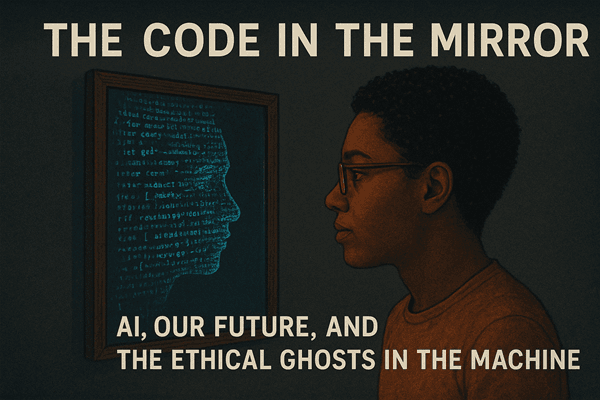
AI is a mirror. Right now, it reflects our deepest flaws. But a mirror can also be a tool for self-reflection. We have the opportunity to look at the biases and defects the AI shows us and, instead of encoding them, finally begin to fix them.