



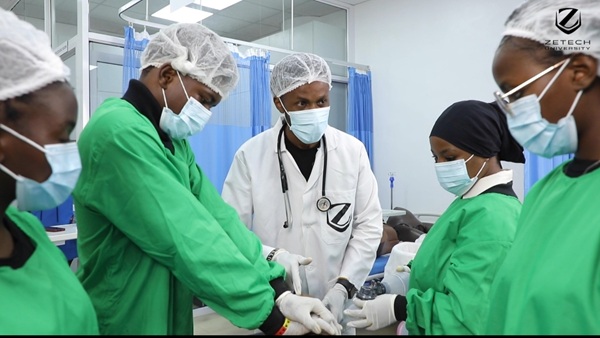
 Zetech University has officially launched its Bachelor of Science in Nursing programme, marking a significant stride in a quest to contribute to Kenya’s healthcare transformation.
The programme’s accreditation by the Nursing Council of Kenya (NCK) and the Commission for University Education (CUE) signals Zetech University’s readiness to offer quality nursing education that aligns with national healthcare standards and meets the country’s growing demand for skilled medical professionals.
Zetech University Vice Chancellor, Prof. Njenga Munene, hailed the development as a historic milestone for the institution and a vital step for the nation. “The approval of this four-year programme is a vote of confidence in our academic excellence and our mission to contribute meaningfully to Kenya’s healthcare system,” he said. “It affirms our commitment to training healthcare professionals who are not only competent but deeply compassionate and ethically grounded.”
The approval of the Bachelor of Science in Nursing at Zetech University also comes at a time of mounting global uncertainty in healthcare funding. In early 2025, the reinstatement and expansion of the U.S. Global Gag Rule, alongside sweeping cuts to foreign health aid through United States Agency for International Development (USAID), have disrupted critical services across sub-Saharan Africa. Against this backdrop, Zetech University’s investment in nursing education is not just timely— it is essential.
As foreign support contracts, the responsibility to sustain healthcare systems increasingly falls to local institutions and professionals. The Nursing programme will be housed under the Zetech School of Health Sciences, at the Technology Park Mang’u Campus and is designed to offer a rich academic and practical experience. Through a blend of classroom instruction, advanced skills laboratories, and clinical placements in top-tier health institutions, students will gain the knowledge and hands-on experience required to address real-world health challenges.
Zetech University Deputy Vice Chancellor, Prof. Alice Njuguna described the programme as a transformative journey that shapes both the hearts and minds of future nurses. “As a university, we have invested heavily in creating a simulation-rich learning environment that prepares our students to deliver care in diverse and dynamic clinical settings,” she said.